What Does Preschool Learning Look Like?
Ask a preschooler what they did at school today and you may hear a very simple answer:
“I played.”
And they’re right. They did play.
But what can be harder to see is just how much learning was happening along the way.
At Early Minds, we believe young children learn best through play, exploration, relationships and hands-on experiences. Preschool learning doesn’t always look like children sitting at desks completing worksheets. Often, it looks like building a tower, mixing paint colors, digging in the sand, pretending to run a restaurant or figuring out how to share materials with a friend.
Behind all of that play, important learning is taking place.
Creating and Imagining
When children paint, draw, build, sculpt or engage in pretend play, they’re doing much more than making something to bring home.
They’re making choices, experimenting with ideas and learning that there can be many ways to solve a problem. A pile of blocks can become a castle. A cardboard box can become a spaceship. Paint colors can be mixed to create an entirely new color.
These experiences encourage creativity, flexible thinking and confidence in children’s own ideas.
Learning to Solve Problems
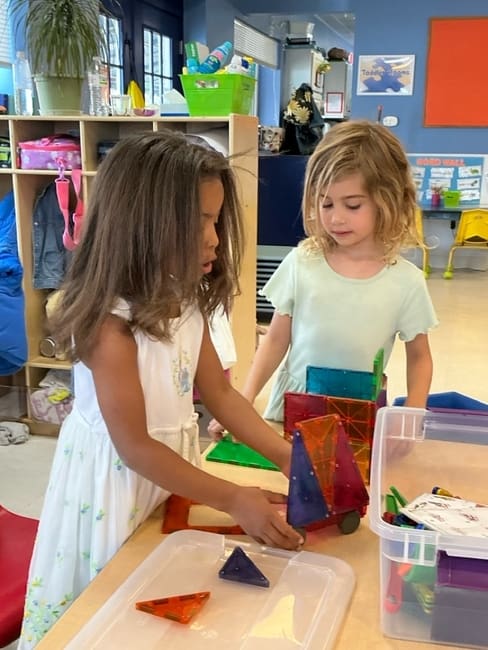
Imagine two children trying to build a tall magnetic-tile tower.
It falls.
They build it again.
It falls again.
So they change the bottom, add more pieces and try one more time.
That is preschool learning.
Children are experimenting, predicting, noticing cause and effect, solving problems and learning something especially important: It’s okay when something doesn’t work the first time.
Building Language
Preschool classrooms are full of conversation.
Children listen to stories, sing songs, ask questions, tell teachers about their ideas and negotiate with friends during play.
A pretend kitchen can become a place to learn new vocabulary. A conversation about an insect found outside can lead to questions about nature. A favorite book can introduce new words and ideas.
Language develops throughout the entire day—not only during a formal lesson.
Developing Early Math and Science Skills
Math and science are everywhere in preschool.
Children count blocks, compare which tower is taller, sort objects, create patterns, measure ingredients, notice changes in the weather and discover what sinks or floats.
When children ask, “What will happen if I do this?” and then try it, they’re already beginning to think like scientists.
These everyday experiences create a foundation for the more formal academic learning that comes later.
Learning How to Be Part of a Group
Some of the most important preschool learning can’t be brought home in a backpack.
Children are learning how to wait for a turn, enter a group that’s already playing, ask for something they want, listen to another person’s idea, handle disappointment and solve disagreements.
Those skills take time and practice.
Teachers help children find the words they need, understand expectations and gradually become more capable of navigating friendships and group experiences independently.
Building Independence and Confidence
Preschoolers want to do things for themselves.
Throughout the day, they have opportunities to make choices, clean up materials, manage belongings, follow classroom routines, attempt new tasks and ask for help when they need it.
Sometimes the greatest learning happens in the moment a child says:
“I can do it.”
That growing sense of competence and independence helps prepare children for the next stage of school—and for much more than school.
Moving, Exploring and Learning With Their Whole Bodies
Young children weren’t designed to sit still for long periods of time.
They need opportunities to run, climb, balance, dig, pour, build and explore.
Movement develops coordination, strength and body awareness, while hands-on activities help children understand concepts in ways that are meaningful to them.
For young children, learning is something they do, not simply something they’re told.
Getting Ready for What Comes Next
Of course, preschool helps children develop early academic skills. They become familiar with letters, sounds, numbers, shapes, patterns, books and writing.
But being ready for kindergarten means more than knowing letters and numbers.
It also means developing curiosity, confidence, independence, communication skills, self-control, persistence and the ability to learn alongside other children.
Those skills develop little by little, through hundreds of ordinary moments throughout the preschool day.
So, What Did Your Child Learn Today?
They may have painted a picture.
Built an enormous tower.
Listened to a story.
Made a new friend.
Dug a river through the sandbox.
Practiced using scissors.
Waited for a turn.
Tried something difficult.
Asked a hundred questions.
And when you ask what they did, they may still tell you:
“I played.”
And that’s exactly what we want.
At Early Minds, play isn’t a break from learning. Play is how young children learn. Through meaningful experiences, caring relationships and plenty of opportunities to explore, children build the skills and confidence they’ll carry with them into kindergarten and beyond.